

Buying an Apartment in Berlin: The Complete Step-by-Step Guide for 2026
Buying an apartment is, for most people, the largest financial decision of their lives.
And yet most buyers enter the process without a clear picture of what actually happens, what comes when, what the real costs are, what to look for at a viewing, and what can go wrong between a handshake agreement and getting the keys.
This guide will help you to draft a plan.
No jargon, no oversimplifications. Just the process, step by step, as it actually works in Berlin in 2026.
Whether you are a first-time buyer, relocating from abroad, or a returning expat navigating the German property system for the first time, this is the guide you need before you start.
Step 1: Set a Realistic Budget
Before you open a single listing, you need one honest number: what can you actually spend?
That number has two components. Your budget and what the market can offer. Your new home sits in the intersection of this two areas.
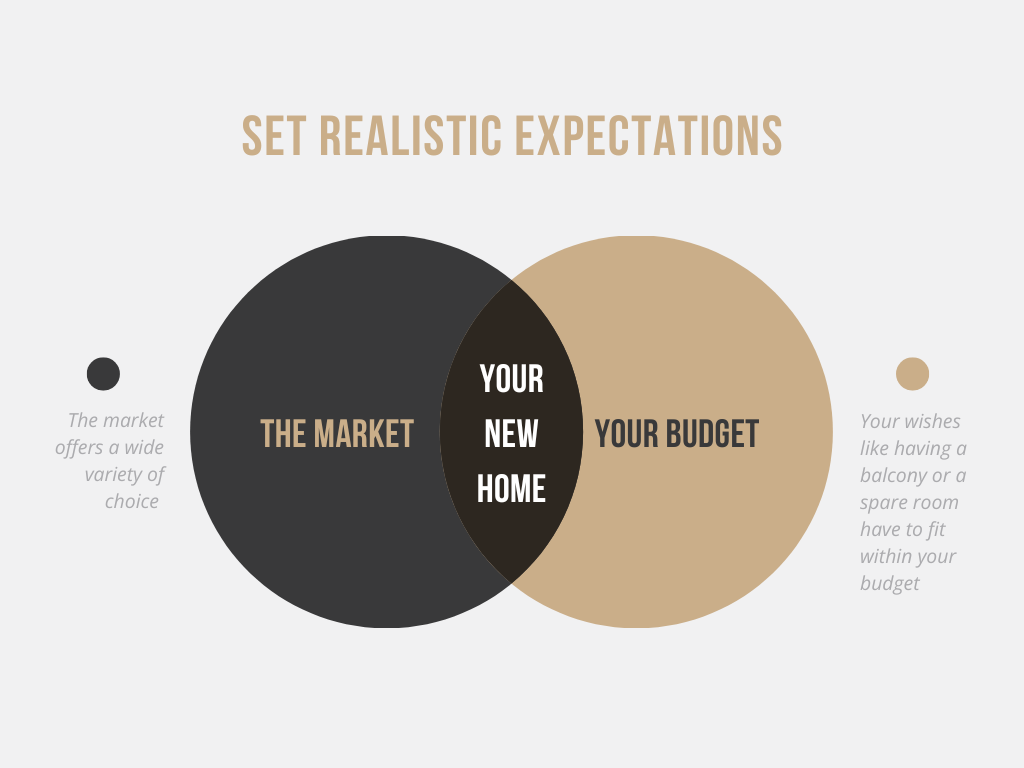
Understanding your budget
German banks typically finance a maximum of 80–90% of the purchase price. In most cases, you will need to bring at least 10–20% of the purchase price as equity. On a €500,000 apartment, that is €50,000–€100,000 from your own funds.
On top of that come the purchase transaction costs — and these are consistently underestimated by first-time buyers, particularly those coming from markets like the UK or the US where these fees are structured differently:
Property transfer tax (Grunderwerbsteuer) 6.0%
Notary and land registry fees approx. 1.5%
Broker commission (buyer side) 3.57% incl. VAT
Total transaction costs approx. 11%
What this means in practice: For a €500,000 apartment, you need roughly €55,000 on top of your equity contribution to the purchase price — and banks generally do not finance transaction costs. They expect you to cover them entirely from your own funds.
In total, plan for at least €100,000 in liquid funds for a €500,000 purchase.
Understanding the market
The market is like the weather, dress accordingly. We can complain about the weather and the market but we can’t go out in a T-shirt in winter and we can’t get a penthouse for € 100,000. You can only choose within the options on the market. Be realistic about what you can get within the budget that you have at your disposal.
Our advice: Get a mortgage pre-approval (Finanzierungsbestätigung) from your bank before you begin actively searching. Sellers and brokers take buyers with confirmed financing significantly more seriously and in a competitive segment, this can be the deciding factor between getting a viewing and being told the apartment is already under offer.
Step 2: Define What You Are Looking For
With a clear budget established, you move to the search. But searching without defined priorities leads to weeks of aimless scrolling and wasted viewings.
Before you open a portal, answer these questions clearly:
Must-haves (non-negotiable):
Which districts are you open to? Berlin is a large, geographically spread city — Prenzlauer Berg and Spandau are not the same market
Minimum size in square metres?
Minimum number of rooms?
Ground floor: acceptable or not?
Lift required?
Nice-to-haves (preferred but flexible):
Balcony or terrace?
Fitted kitchen included?
Condition: move-in ready, or are you open to renovation?
Parking space or garage?
Dealbreakers (immediate rejection):
Heavy road or tram noise?
No U-Bahn or S-Bahn within walking distance?
Specific building types or construction eras to avoid?
This list saves you weeks. It also makes working with a broker far more productive — a buyer who knows what they want gets better results than one who is still figuring it out.
Step 3: The Search — Where and How
The major portals
ImmoScout24 is by far the most widely used property portal in Berlin — by both buyers and brokers. Set up a saved search with email notifications for your criteria. In competitive segments, new listings receive dozens of inquiries within the first 24–48 hours.
Immowelt and Kleinanzeigen (formerly eBay Kleinanzeigen) complement the search but have significantly less volume in the Berlin residential purchase market.
Off-market properties
A meaningful share of Berlin property transactions happen away from the public portals entirely. Brokers with active buyer networks match registered buyers to properties directly — before a listing goes live, or instead of one.
If you have a clear profile, it is worth registering as a buyer with local brokers in your target districts. It costs you nothing, and it opens access to a market many buyers never see.
At Brancaccio Properties, we maintain an active buyer database. If you share your search criteria with us, we will contact you directly when a matching property becomes available — including off-market opportunities. Register as a buyer →
How fast do you need to move?
In Berlin's mid-market segment (€300,000–€700,000), well-priced apartments in desirable locations routinely receive 30–50 inquiries within the first 48 hours of listing. Viewings are often allocated within the first week.
This means your financing should be in place before you start searching, and your decision criteria should be defined well enough that you can respond to a new listing within hours — not days.
Step 4: Viewings — What to Actually Look For
A viewing typically lasts 20–30 minutes. In that time, you need to ask a lot of questions. Don’t be afraid to look inexperienced, nobody buy properties on a regular basis. The broker knows you’re about to make one of the most important decision of your life.
The apartment itself
The best advice I can give here is to get to know the property and listen to your gut feeling. Choosing a property is an emotional process while buying one is more of a technical one. The first viewing should answer one question: can I live in this place and in this neighborhood? Bear in mind that you will never find the perfect apartment even with all the money in the world. A successful apartment find is made of a series of compromises and trade-offs you can live with. Understand the difference between features that are nice to have and the features you need.
The second viewing are divided in two types. If the apartment is renovated or in a good condition and you don’t plan to refurbish it, bring a real estate surveyor. Not an architect, not a friend who happens to be handy. An architect will guess the humidity in a stain while a surveyor will tell you how much water is in the wall in %. He can find things that are invisible to the landlord.
Then there is the project. It’s the kind of apartment that is old and outdated and need a complete rebuilt. In this case you need a construction company that will give you an idea of the cost of building your vision for that property. Ask them for a detailed estimation with all parts and prices so adjust the renovation price by closing premium material or more cost efficient.
Important: depart from the idea that the apartment needs to be perfect because you’re going to spend the rest of your days there. You’re not. It’s going to be your home for a while until your life will change, which will affect your needs. Your new needs will no longer fit into the property and at that time you will sell this real estate and buy a new home. Job, relationship, children are major drivers. Don’t be afraid of these changes.
The building and the owners' association (WEG)
When you buy a flat in Germany, you are not just buying the apartment — you are buying into a Wohnungseigentümergemeinschaft (WEG), the shared ownership community of all apartment owners in the building. This has real financial implications.
Ask explicitly about:
Protocols of the last three WEG annual meetings (Protokolle): Are there ongoing disputes? What decisions have been made or are pending?
Maintenance reserve (Instandhaltungsrücklage): How well funded is it? A low reserve means future major repairs — roof, facade, lift — will be billed as a special levy (Sonderumlage) to all owners, including you.
Planned renovations: Is an energy retrofit planned or already agreed? This could become your financial obligation as the new owner.
Monthly WEG fees (Hausgeld): What is included, and how does it compare to similar buildings?
Current land register extract (Grundbuchauszug)
Energy performance certificate (Energieausweis) — legally required in every listing
Declaration of division (Teilungserklärung) and house rules (Gemeinschaftsordnung)
Current tenancy agreement if the apartment is rented out
Step 5: Making an Offer — How to Negotiate Effectively
You have done the viewing, reviewed the documents, and your interest is serious. Now comes the negotiation.
How much room is there to negotiate?
There is no universal answer — it depends entirely on the specific property's market position:
Apartments with multiple interested parties and short time on market have little to no negotiating room
Listings that have been active for 60+ days often have meaningful room — but always ask why
Renovation requirements can be argued through concrete cost estimates
How to structure your offer
Make your offer in writing, clearly stating: purchase price, preferred possession date, and any conditions
Attach your mortgage pre-approval and a proof of fund. This separates you from unqualified enquiries and signals that you can close
Don’t make it about the money. The price is the unit of measure of the convenience. Discuss possession date, fixtures and fittings (kitchen, cellar, parking space) are all part of the deal
Step 6: Finalising Your Financing
Once buyer and seller are aligned, the clock starts. The seller expects financing confirmation promptly, typically within two to three weeks.
What your bank will need
Every lender has its own checklist, but typically:
Draft purchase contract (from the notary)
Land register extract
Property listing with photos and floor plan
WEG annual accounts and declaration of division
Often a floor plan with measurements and a surface calculation
Your income documentation, bank statements, and tax assessments
Fixing your rate and repayment
In a market with mortgage rates around 3.3–3.8% (as of 2026), most buyers benefit from a fixed rate period of 10–15 years — providing payment security and protection against rate increases at refinancing.
An initial repayment rate of at least 2% is advisable. At 2% repayment plus 3.5% interest, you repay the loan over approximately 25–30 years — without being dependent on favourable refinancing conditions decades from now.
Tip for international buyers: German banks are generally accessible to non-residents and non-citizens, though documentation requirements are more extensive and some lenders restrict loan-to-value ratios for non-residents. Independent mortgage brokers such as Dr. Klein or Interhyp have access to a wide lender panel and can significantly improve your terms compared to going to a single bank directly.
Step 7: The Notary Appointment — What Actually Happens
The notary appointment (Beurkundungstermin) is the legally decisive step in the German property purchase process. This is where the purchase contract is formally executed and the transfer of ownership is initiated.
Who chooses the notary?
In Germany, the notary is legally neutral, they represent neither buyer nor seller, but the correct legal execution of the transaction. The buyer typically proposes the notary but not always. In some cases like a new division or a new project, the contract is drafted by the the notary who made the partition deed.
What happens before the appointment?
The notary drafts the purchase contract and sends it to both parties at least 14 days before the appointment (the legal minimum)
Read the contract carefully. If anything is unclear, ask the notary directly, this is their job and there is no extra charge for questions
Resolve any outstanding points (possession date, fixtures, known defects) before the appointment, not during it
What happens at the appointment?
The notary reads the full purchase contract aloud — the entire document
Both parties may ask questions at any point
All parties sign
The notary applies for a priority notice of conveyance (Auflassungsvormerkung) to be entered in the land register. This protects your claim as buyer before formal ownership transfer is complete
What happens after the appointment?
1. Payments
The following payments will be due in the coming days:
Notary fees (1.5% to 2%)
Property transfer tax (6% of the purchase price)
Broker’s commission (3.57% VAT included)
2. Priority Notice of Conveyance
The notary will have the priority notice of conveyance entered in the land register. This process usually takes 6 to 8 weeks.
3. Deletion of Land Charge (if the seller has a mortgage on the property)
At the same time, the notary will request the deletion authorization from the bank. Once the land charge is removedfrom the land register and the priority notice of conveyance is entered, the requirements for the payment due notification will be met.
4. Purchase Price Payment
Two payments are to be made:
One to the bank (if there is a mortgage)
One to the seller
As soon as the seller confirms receipt of the purchase price, the handover of the apartment will take place.
Step 8: Payment, Handover, and Moving In
Paying the purchase price
You transfer the purchase price only after receiving the official payment due notice (Fälligkeitsmitteilung) from the notary. This confirms that all preconditions for a secure payment have been met — including the registered priority notice and the release of any existing charges on the property.
Never transfer funds before receiving this notice. This is not overcaution — it is the standard process, and it exists to protect you.
The handover
On handover day:
Create a detailed handover report (Übergabeprotokoll)
Record meter readings for electricity, gas, and water
Confirm that all keys are handed over
Verify that any included fixtures or fittings (kitchen, cellar, parking space) are present as agreed
The Most Common Mistakes Berlin Apartment Buyers Make
To close — the errors we see most frequently, and how to avoid them:
1. Underestimating transaction costs. Many buyers plan only for the purchase price. The 11% in transaction costs then arrives as a painful surprise.
2. Searching without mortgage pre-approval. In a competitive market, you will not be taken seriously for desirable properties without confirmed financing.
3. Not reading the WEG documents. The meeting minutes are dry reading — but they reveal whether the roof needs replacing, whether there are persistent disputes among owners, and whether a special levy is imminent.
4. Falling in love before doing the maths. Emotional decisions at viewings lead to overlooked defects and insufficiently challenged asking prices.
5. Reading the purchase contract for the first time at the notary. The notary appointment is not the moment to review the contract. That should happen days in advance.
6. Negotiating without market data. If you do not know what comparable apartments have actually sold for — not asking prices, actual transaction prices — you are negotiating blind.
Looking to Buy in Berlin? Let's Talk.
At Brancaccio Properties, we work with buyers from the initial search through to handover. We know the Berlin market from daily transaction practice — not from statistics — and we maintain an active portfolio of properties, including off-market opportunities that never reach the public portals.
Registration as a buyer is free and comes with no obligation.